
The Blockchain Trilemma
Balancing Scalability, Security, and Decentralization


Traditionally, trusted services have required centralized intermediaries to operate at scale. Platforms like Amazon, ebay and Paypal are examples of fully centralized digital trust intermediaries that use data aggregation and processing to provide trusted services at scale. But these services also come at a cost, as all that data that’s being aggregated and processed is your data. Well, not really. You see, it’s data about you, but you don’t actually own it; the intermediaries do.
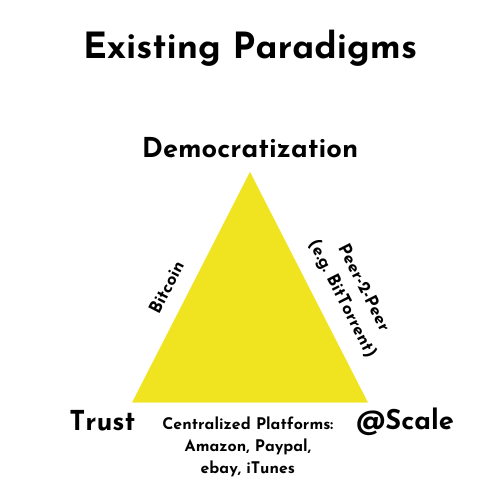
Blockchain technology replaces centralized systems with decentralization, and in so doing, eliminates the need for intermediaries. This also impacts the security and scalability and how the three variable relate to one another in the pyramid. With decentralization now topping the pyramid
The Blockchain Trilemma — the inability of a blockchain to achieve complete decentralization, security and scalability all at once — is a challenge faced by many blockchain networks and has been a major obstacle in the development of blockchain networks.
Decentralization is measured by the distribution of nodes, or computers, that are part of the network. The more nodes there are in the network, the more decentralized it is. A more decentralized network is more secure, as it is less vulnerable to attack or manipulation by a single entity. Furthermore, a more decentralized network is more resistant to changes in the network, as there is no single point of failure.
When measuring decentralization of a blockchain protocols, we look at the number of nodes that are part of the network, as well as how distributed those nodes are. A blockchain network that has more nodes and a more evenly distributed network of nodes is considered to be more decentralized.
Furthermore, the consensus mechanism that a blockchain uses can have a significant impact on the level of decentralization. Proof-of-Work and Proof-of-Stake are two of the most popular consensus mechanisms that blockchain networks use to verify new transactions, add them to the blockchain, and create new tokens.
Proof-of-Work is a consensus mechanism in which nodes are required to “prove” that they have performed a certain amount of work in order to add a new block to the chain.
Proof-of-Stake is a consensus mechanism in which nodes must “stake” a certain amount of tokens in order to participate in the consensus process. This helps to ensure that the network remains decentralized and resistant to manipulation by any single entity. Proof-of-Stake is typically considered more decentralized than a network using a Proof-of-Work consensus mechanism.
The scalability of a blockchain network refers to its ability to process a large number of transactions in a short amount of time. If a blockchain network is not able to process transactions quickly, it can cause delays and result in poor user experience.
A protocol is said to be scalable if it is able to efficiently increase its performance as more resources are added. This scalability can be divided into two categories: vertical scaling and horizontal scaling.
Vertical scaling looks at how the performance of the blockchain changes as the resources available to each node increase, such as computational power, storage, communication bandwidth and latency. Horizontal scaling, on the other hand, looks at how the performance of the blockchain changes as the number of nodes increases.
Security is the third critical component of a blockchain network. If a blockchain network is not secure, it can be vulnerable to attack, resulting in the loss of user funds or the manipulation of data. Security is a critical aspect of any blockchain protocol, and it is important to be able to measure it accurately. There are several metrics that can be used to measure the security of a blockchain protocol, such as the amount of decentralization, the consensus mechanism used, and the number of nodes in the network.
The blockchain trilemma is the challenge of finding a way to balance scalability, security, and decentralization. To date, there is no perfect solution to this problem, but there are a few methods that have been explored.
One of the most popular methods is the use of layer 2 blockchains. Layer 2 blockchains are built on top of layer 1 blockchains and are designed to handle smart contracts and transactions off-chain. This allows them to improve scalability and increase throughput without sacrificing decentralization or security.
For example, Polygon is an Ethereum-compatible, layer-2 blockchain that provides a suite of solutions to help developers build and scale dApps. It uses a combination of sidechains, state channels, and plasma to increase the throughput of transactions on the Ethereum blockchain. By doing this, Polygon is able to improve scalability and lower transaction costs while still allowing developers to build on an Ethereum-compatible network.
Another popular method is the use of sharding. Sharding is a process in which a blockchain network is divided into smaller, independent units called shards. Each shard is responsible for processing a subset of the network’s transactions, allowing for greater scalability and throughput.
Ultimately, the blockchain trilemma is a complex challenge that requires ongoing research and development in order to find the best solutions. As more projects explore the potential of layer 2 blockchains and sharding, we may find new ways to balance scalability, security, and decentralization.